
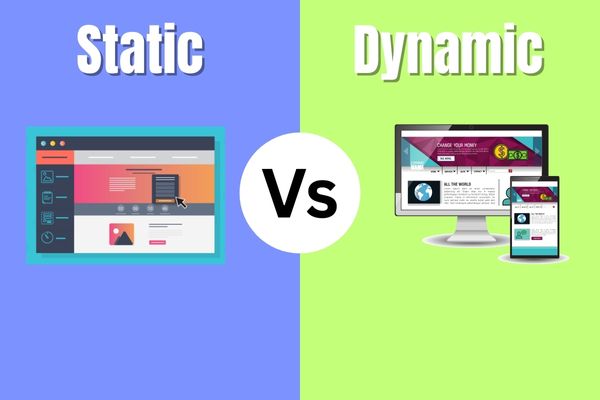
The choice over static vs dynamic website isn’t an easy one because it influences how your website functions, how people engage with it, and whether you will achieve your objectives. Because each form has advantages and disadvantages, it might be difficult to decide, particularly if you’re new to web design.
Static and dynamic describe how websites present and distribute content in the context of website development. The main distinction between static vs dynamic websites is that dynamic websites pull material on the go, enabling it to vary with the user, whereas static websites have static content, where every user sees the exact same item on each unique page (such as a privacy policy).
What is a Static Website?
You can see a static website as a digital flyer. It consists of pre-made files created with JavaScript, HTML, and CSS. The server provides these files exactly as they are, unaltered, when someone visits your website.
To create static websites, you need static site generators, which help facilitate the website-building process using simple web languages. They are quick and safe since they don’t use complicated server programming or databases. However, you must update the actual code to modify the information, which might be challenging for those who need to learn how to code.
Why do people choose a Static Website?
Businesses that prefer creating static websites do so for several reasons. Here are a few reasons for such a decision.
Fast Loading Speed
A static page’s structure prioritizes load speed, making browsing more enjoyable. This kind of website’s content is pre-written and served straight from the server, making caching simpler and reducing the likelihood of content loading slowly or experiencing UX problems like broken pictures.
Static websites are inherently speedier since they don’t require a database or client-server architecture. They also demand less server power. Given that Google evaluates a website’s performance in large part based on page load speed

Easy to build
Static websites are typically easier to create than dynamic ones as they don’t involve intricate server-side programming. Because of this, anybody with little knowledge of Web programming may use them.
Low hosting costs
Compared to dynamic websites, static websites frequently offer low hosting costs and require less continuous maintenance. They may therefore be a more affordable choice, particularly for small enterprises or individual endeavors.
Improved security
Static websites are hard for hackers to attack. The reason behind this is that there are fewer pages available to attack. Static pages don’t need external extensions, plugins, or database connections, all of which can be frequent ports of entry for assaults. Static websites are theoretically less vulnerable to prospective attackers, yet dynamic websites are not intrinsically dangerous.
Drawbacks of a Static Website
Despite the benefits of using a static website, it still has certain drawbacks.
Harder to update
You must update each file before re-uploading it to your server if you want to make changes. As the size of your website increases, this might become more challenging. Although this procedure may be made easier with the use of static site generators, it is still far more difficult than maintaining a dynamic website.
Limited Functionality
One of the biggest drawbacks of static websites only applies to larger, more content-rich designs. Although creating hundreds of pages on a static website is feasible, it will always be a tedious process.
However, this is less important when making a personal website. A static website requires each page to be constructed as a distinct entity. You would have to make each page of a multi-page website separately.
Absence of customization
You can’t simply add customization to your static website since each visitor is sent the same static file (unless you utilize JavaScript on the client side). This might reduce the usability of your website and affect how successful your marketing campaigns are.

What is a Dynamic Website?
A dynamic website changes in response to user input or real-time data, making it more engaging than a static website. Consider an online store where product availability and pricing change over time; this calls for a dynamic website to show the most recent data.
Databases and server-side programming languages like PHP, Ruby, or Python are used to create dynamic websites that produce content in real time.
Why do people choose a Dynamic Website?
Like static websites, dynamic website also comes with several benefits. These benefits are the reasons businesses and organizations choose a dynamic website.
Easily updatable
Continually updated content is essential for launching a business and developing an online identity. You must keep up with changes, upgrades, and trends in both your sector and your company. The best way to accomplish this is via a dynamic website.
A dynamic website eliminates the need to update the design by instantly replicating a change in information on one page to other pages. This is especially important for websites with many pages since it improves the efficiency of website maintenance.
Greater functionality
Although static sites can be interactive, dynamic pages are unquestionably superior in terms of functionality. The intricacy of the concepts and language required to construct them, as well as the instructions required to supply material, are the only limitations on the infinite capability of dynamic pages.
Drawbacks of a Dynamic Website
Cost
They are more expensive. A dynamic website is more costly to create and manage than a static one. Strong web hosting features and frequent audits will cost you more than developers and designers.
Complex maintenance
Performance tweaking, patches, and regular upgrades need a lot of continuous work.
Technical requirements
For efficient administration and maintenance, a diversified technical staff is frequently required.
Performance issues
Compared to static websites, dynamic websites must handle more instructions. Additionally, they are linked to a database or content collection, from which they continuously extract material for display, which requires processing and execution time.
Although many website development tools recognize the importance of this problem and make it their goal to emphasize efficiency across all pages, this can have an influence on a site’s performance.
Static vs Dynamic Website: Key Differences
There are a few ways to distinguish between static vs dynamic website. Let’s look at the functionality, complexity, and security aspect that makes them different.
Complexity
Static websites are simpler than dynamic ones. Chunks of text, programming language-coded scripts, databases, and web apps that handle additional functionality are all components of dynamic web pages. Static pages are just pre-built, fixed pages that open and don’t do anything else.

Functionality
The functionality of static webpages is restricted. Visitors to static pages are shown consistent content that only infrequently needs refreshes. Dynamic websites contain more dynamic elements. Customized site content, shopping cart placement, item payment, and form completion are all available to visitors.
Security
Static websites are theoretically more difficult to compromise. Until an HTML request retrieves the page and displays it in the browser, static web pages remain on a server. Static web pages don’t really involve any interaction; thus, the files are safe until there is a web server breach.
Static vs Dynamic Website: What is the best option?
Do you have a clue about a static or dynamic website? There are several static and dynamic website examples but the most common for a static website is a brochure site whereas Facebook, YouTube is an example of dynamic website.
For straightforward informational websites like portfolios or brochure sites that don’t need to be updated often, static websites are perfect. A static website is cost-effective and preferable if your small business needs an online presence with basic information like contact details, services, and a map.
However, you need a dynamic website if it requires user logins or offers personalized content, such as dashboards or tailored suggestions. Dynamic functionality is crucial for companies operating a commerce platform to manage product listings, shopping carts, and payment processing.
Conclusion
A clear understanding of static vs dynamic websites is necessary to choose the appropriate strategy based on your website’s goals. Dynamic pages are more adaptable and interactive, making them more appropriate for complex, user-driven websites, but static pages are simpler to use and load faster.
Leave a Reply