
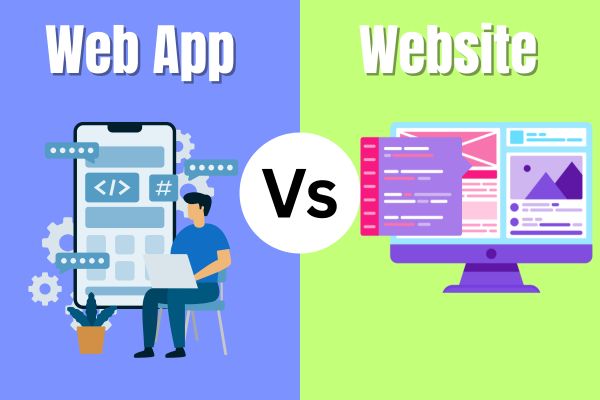
Understanding that Web App vs website is beyond terminology, as it is the bridge to creating a tool and experiencing it. While both terms are interchangeably used, most people still fail to understand that they aren’t the same. However, if you are a developer, it is even more important to know these concepts in your web-building journey.
There are several aspects to look at regarding web app vs website, but this article will explore key features and their limitations. Every section will provide a concise explanation with examples. Let’s get started.
Understanding the Concept of a Website
Let’s begin with the hypothesis. A website represents a collection of logically arranged elements shown to a user via a web browser on a single domain name. In most cases, you would use anchor links and navigation to connect the components.
Every website a developer creates has a particular purpose, with each varying. For example, business websites are designed to give broad information about the firm, whereas blogs offer fun, practical information, or helpful pieces.
You can use several devices to access a website if you have the website address. These devices include laptop, tablets, smartphones, and desktop computer. In website development, the popular technologies developers use are PHP, JavaScript and CSS.
Characteristics of a website
- Highly responsive
- Optimized for search engines
- Load fasters
- User-friendly
- Attractive design
- Easy to navigate
- Quality & relevant content
What is a Web Application?
A web application is a piece of software that is accessible through a web browser and operates on a web server. Web apps enable users to carry out actions like completing forms, transmitting data, or engaging with live material.
Because they are interactive, web apps frequently need backend processing to process data, manage requests, and authenticate users. To store and retrieve data, they depend on databases and server-side technology.
When Do You Need a Web App?
Custom web application development is the best option when establishing anything that involves several complex procedures. For instance, if you are creating an eCommerce store, in such a case, a web app will function better. As a result, you can have several processes operating concurrently within a single system.
Characteristics of a web App
- Supports cross-platform
- Scalable and cloud hosted
- Modular and roughly coupled
Misconceptions about Web App vs Website
In this section, we’ll address common misconceptions about web app vs websites to help you better understand their unique purposes and functionalities.
You can use web apps as mobile applications
The development, deployment, and accessibility of mobile and web apps varies. Although they are not installed on mobile devices, anyone can access and operate web applications in a web browser.
Installing mobile apps is necessary, and distinct versions for operating systems, such as iOS or Android, must be created. While certain online apps may be transformed into progressive web apps (PWAs) to operate similarly to mobile apps, they remain different from native mobile apps.

Any website with interactive features works as a web app
A website is not always a web application just because it has interactive features and parts. Even if a website has interactive elements, such as instructional websites with quick quizzes, it still counts as a website to the extent that its main objective is to offer material. Web apps are task-oriented and can process data; for example, Google apps can create and modify documents. There are several practical web app vs website examples from Airbnb, Google, and more.
A web app represents a website with advanced functionalities
Remarkably, this isn’t true. Although web apps are technically incorporated on web pages, their functions are what really distinguish them. Web applications are made to carry out more complicated activities, whereas websites are mostly intended to convey content and information.
A task management tool like Trello is a web application, as it enables users to create, manage, and modify task data, while an e-commerce site that displays and sells things is still a website.
Web App vs Website: Understanding the Key Differences
In looking at the Web App vs Website differences, here are a few things to take notice of that will enable you to differentiate them properly.
Interactivity
With minimal possibility for user interaction, websites primarily provide consumers with content and visuals to browse and read. While navigation menus and other basic elements like buttons and forms are commonly seen on websites, their main purpose is usually to improve information or help users navigate between pages.
In contrast, web applications are highly interactive and designed for personalized user engagement. A user can do activities and receive results based on their actions when they modify an interface or alter data. You are undoubtedly already familiar with certain examples of web apps, such as social networking platforms, project management software, and online banking websites.
Functionality
Most conventional website functionality is provided by the links in the navigation menu, which allow visitors to navigate to the site’s many web pages. They may use the scrollbar on the web browser to navigate longer pages.
The goal is to present content that visitors may passively explore or consume. Some elements, like as media players or registration forms, may encourage little involvement, but also prevent users from entering or changing data to complete tasks or resolve problems.
Conversely, a web application can offer any sort of basic or advanced functionality, allowing users to do activities like those that can be completed with desktop or mobile apps.
Web App vs Website: Technological Tools
Web apps need the development of backends using several technologies, such as PHP and Node.js, together with various frontend technologies, such as React, Angular, or Vue, whereas developers utilize HTML, CSS, and JavaScript to construct websites. Below are brief descriptions of each to assist you understand when to use them.
- React is a JavaScript tool that makes it easier to create engaging and dynamic online apps. Developers can save time by using pre-made and customizable components.
- Vue: You can use this framework to build eye-catching user interfaces. Developers may quickly design web apps with exceptional integration capabilities, flexibility, and time-saving features.
- Node.js: This environment, which runs server-side JavaScript applications, allows developers to successfully create web apps.
- PHP: This method works well for developing dynamic web applications. Many PHP frameworks and heavy-load modules make the language quick and simple to use.
- Angular: This is an open-source web application framework developed by Google that is widely used in the development of online applications. It is powered by extensions and features that improve functionality. The two most widely used Angular-based apps are Gmail and PayPal.
While all these tools are important, the significant factor is the cost. The web app vs website cost comes with hidden charges such as real-time features, authentication, and API integration.
Which One Do You Need?
You might need a website or a web application, depending on your goals. If your only objective is to establish an online presence or provide information, a website will suffice. However, a web application is a superior solution if you need to preserve data, provide interactive features, or carry out extra operations.
Conclusion
It is crucial to know that a web app vs website differs while organizing your online presence. A web application is made for interaction, user involvement, and real-time functioning, whereas a website is mostly used as an informative platform.
Your audience’s demands, technological specifications, and commercial objectives will determine which option is best for you. A successful online strategy starts with the appropriate decision, whether you require a feature-rich web application or a content-driven website.
Leave a Reply